24,000 Clicks, 3 Enquiries: The Conversion Rate Nobody Tells You to Expect
I audited an account recently for the owner of a pest control company. He treats infestations in homes and commercial buildings, the sort of job people ring about the same day they find the problem.
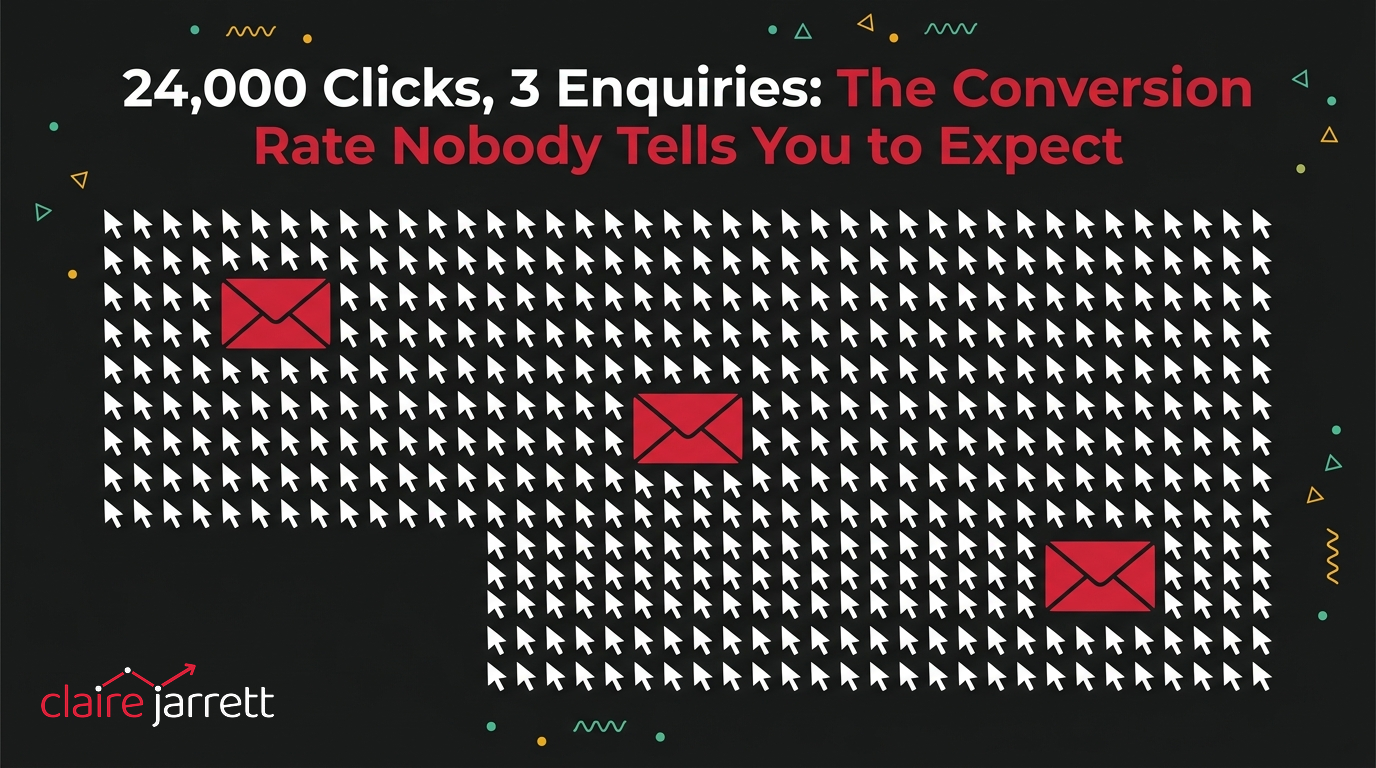
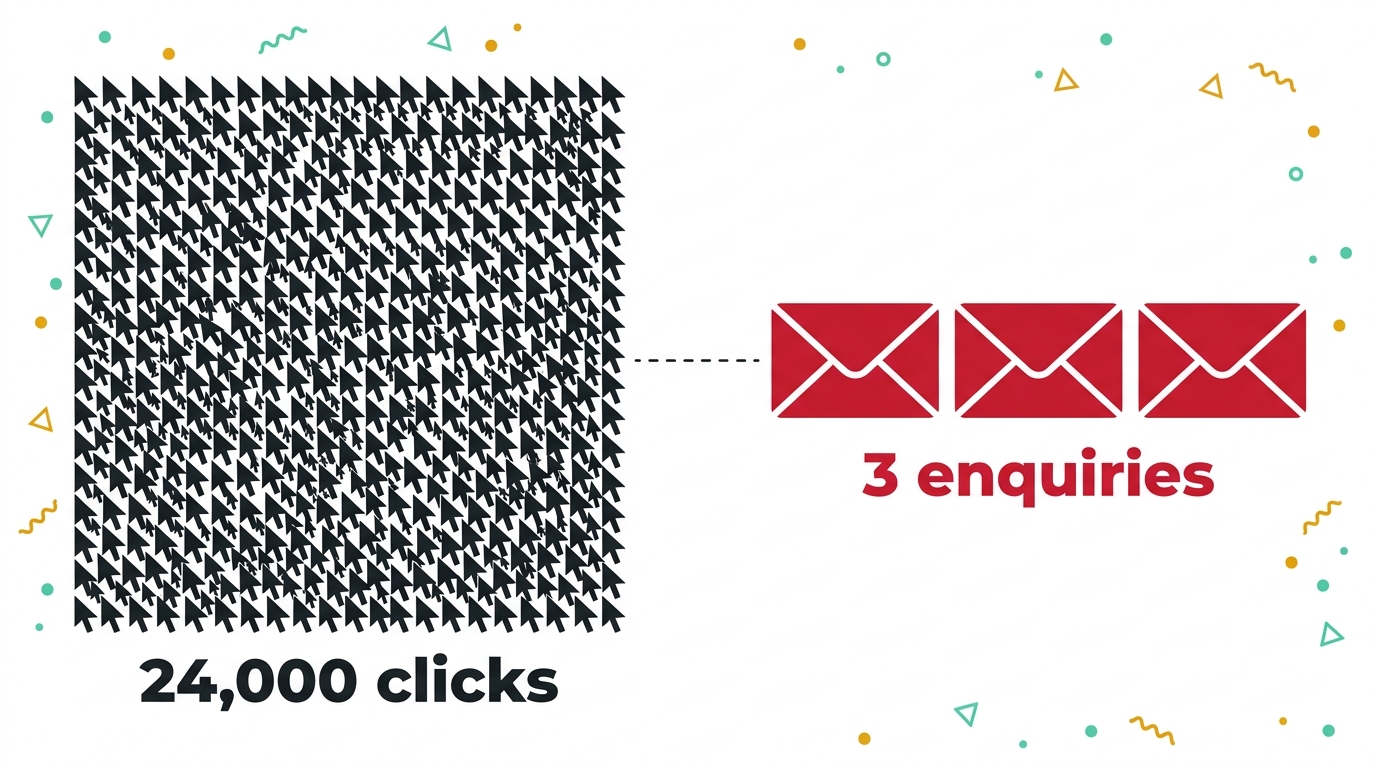
The campaign that had spent the most had gone through $2,260. It was set to maximise conversions. The number of conversions it had ever recorded was 3.
Across the life of the account, that owner had paid for around 24,000 clicks.
He knew it wasn’t working. What he couldn’t tell me was how far off it was, because nobody had ever told him what the number was supposed to be.
Nobody gives business owners the benchmark
This is the gap I run into more than almost anything else. An owner can tell me their spend, their cost per click, sometimes their cost per conversion. Ask them what conversion rate they should be getting and there’s a pause.
It isn’t a silly question to not know the answer to. Google doesn’t show you a target. Your account doesn’t flag it. The number sits there on the screen looking like a fact rather than a verdict.
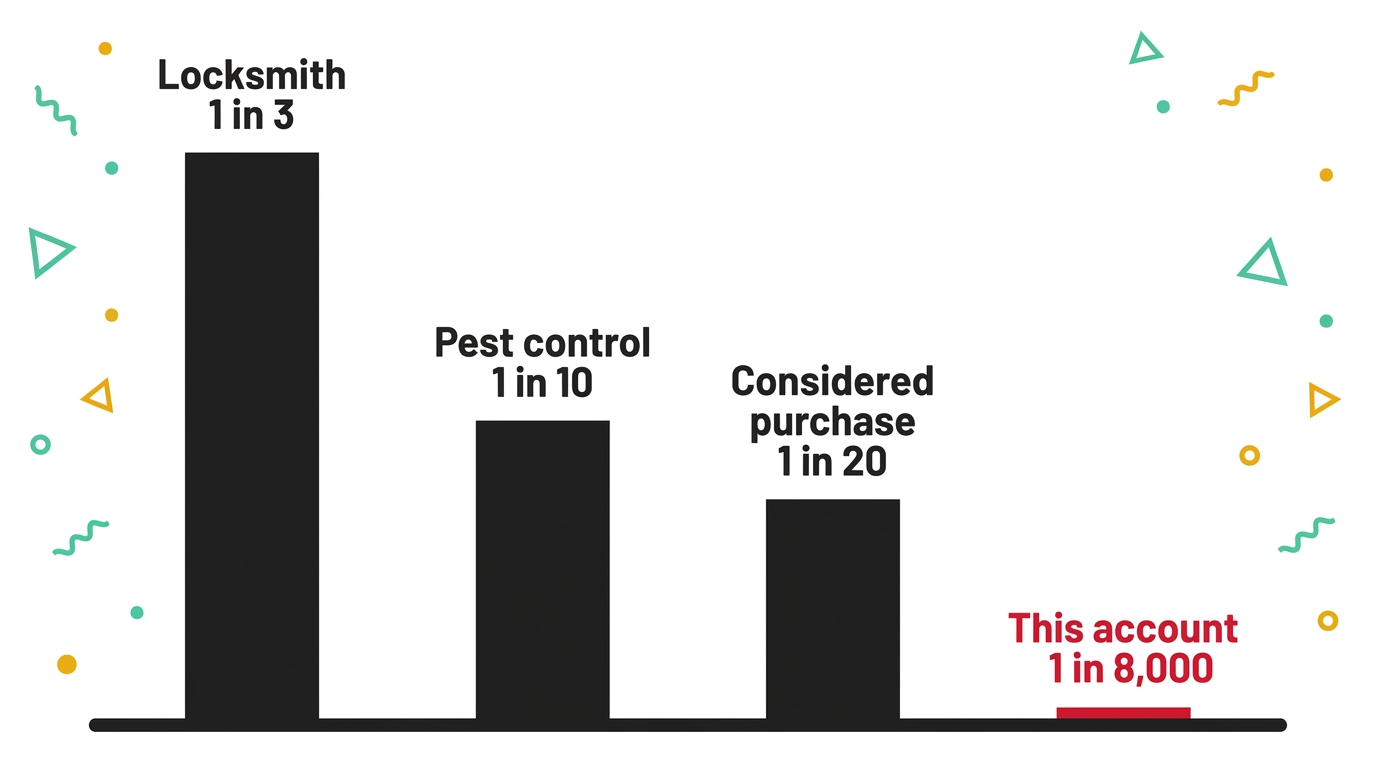
So here is the one I work to. On a search campaign that’s properly built, sending traffic to a page made for that traffic, I’m aiming for 1 in 10 to convert. 1 in 20 at the low end.
My husband is a locksmith. His conversion rates are more like 1 in 3, 1 in 4, because somebody locked out of their house at 9pm is not browsing.
Pest control sits closer to the locksmith end than most industries do. Somebody who has just found evidence of an infestation in their kitchen is not doing 6 weeks of research.
At 1 in 10, 24,000 clicks is 2,400 enquiries. This account had 3.
That’s not a small inefficiency, and it isn’t bad luck. A gap that size means the traffic was never the right traffic in the first place.
What was actually happening
Nothing in that account was telling Google what a good customer looked like.
The conversion tracking had never been set up properly, so the campaign had almost no real signal to learn from. Then it was asked to maximise conversions, a strategy that works by studying the conversions you’ve already had.
3 conversions is not something to study. So Google did the only thing left available to it: it went and found the clicks it could get most easily and most cheaply.
Cheap clicks in a trade like this are almost always people searching for how to sort the problem out themselves. There are far more of those searches than there are of the ones worth having.
That’s the same mechanism behind an account paying a few cents a click and treating it as good news. The traffic was affordable because nobody else wanted it.
It’s also why an untouched account gets worse rather than staying still, which is what the change history will usually show you if you go and look.
How to work out what your own rate should be
- Divide your enquiries by your clicks, over the last 90 days, not the last week. Conversion rate on 40 clicks tells you nothing. Take a long enough window that the number is stable, then compare it to 1 in 10. If you’re at 1 in 100, the problem is not your bidding, it’s who is arriving.
- Ask how urgent your customer is when they search. Emergency trades, same-day services and anything with a burst pipe or a wasp nest attached should be at the higher end. Considered purchases, professional services and anything with a long decision behind it will sit lower, and that’s fine, as long as you know which one you are before you judge the number.
What a bad rate is usually caused by
- The traffic. Broad keywords bringing in people researching rather than buying. This is the most common cause by a distance, and it’s fixed with tighter keywords and proper negatives, not with a bigger budget.
- The page. Ads pointing at a homepage that asks the visitor to work out where to go next. A page built for the search will normally do 2 to 4 times what a homepage does on the same traffic.
- The measurement. An account that genuinely is converting but isn’t recording it. Worth ruling out first, because everything else you do off the back of a wrong number will also be wrong, and dashboards do lie.
The bigger point
A number you can’t judge is not information. It’s just a number on a screen that you look at and feel vaguely uneasy about.
The owner of that pest control company had been staring at his account for months. He knew something was wrong. He had no framework to say how wrong, which meant he had no way to decide whether it needed adjusting or gutting.
It needed gutting. I’d rather tell someone that plainly than let them spend another 6 months adjusting.
The benchmark is the useful bit here, not the horror story. Once you know that 1 in 10 is the target, your own account stops being a mystery and becomes a fairly simple piece of arithmetic. Any PPC consultant worth their fee should be able to tell you what rate they expect from your market before they touch anything.
If you want to sanity check yours, the audit checklist covers where to look. You know where I am.
A few questions I get asked
Is 1 in 10 realistic for every business? No. It’s the target I work to for search campaigns in service businesses with a page built for the traffic. Some markets sit lower for perfectly good reasons, particularly where the purchase is a big one and people compare 4 or 5 providers before they contact anyone. The point isn’t the exact figure, it’s having one at all, so you can tell the difference between a normal rate and a broken one.
My conversion rate looks fine. Does that mean the account is healthy? Not necessarily. A healthy looking rate on the wrong conversion action is a very common way to be reassured by nothing. If your account is counting page views, phone clicks that nobody answered, or people who were already searching for you by name, the rate will look respectable while the business sees very little. Check what is being counted before you trust the percentage.
Should I fix the traffic or the landing page first? The traffic, almost always. A better page cannot rescue an audience that was never going to buy, whereas the right audience will convert at some rate even on a mediocre page. Get the keywords and negatives right, then improve the page and watch the same traffic do more.
How long before I can judge a new campaign on this? I’d want at least 300 clicks before drawing any conclusion, and ideally 90 days. Judging a conversion rate on a fortnight of data is how perfectly good campaigns get switched off and genuinely broken ones get left running.
2 ways I can help you get this right
If you want to know what conversion rate your market should be producing, and what yours is actually doing, book a free call and we’ll go through the account together.
If you’d rather learn to read these numbers yourself and build an account that doesn’t need rescuing, my masterclass How to Overtake Your Top Google Ads Competitors in 8 Weeks walks through exactly that.

Claire Jarrett
Google Ads consultant since 2007, published author (6 books), and Google Partner. Claire was the first person to launch Google Ads training in Europe and has helped thousands of professional service businesses scale their leads.
More about Claire