61 Clicks, 0 Conversions: The Folder Nobody Ever Sorted
I audited an account recently for the owner of a podiatry clinic who’d been through 2 or 3 agencies over the last year, trying to get Google Ads to work.
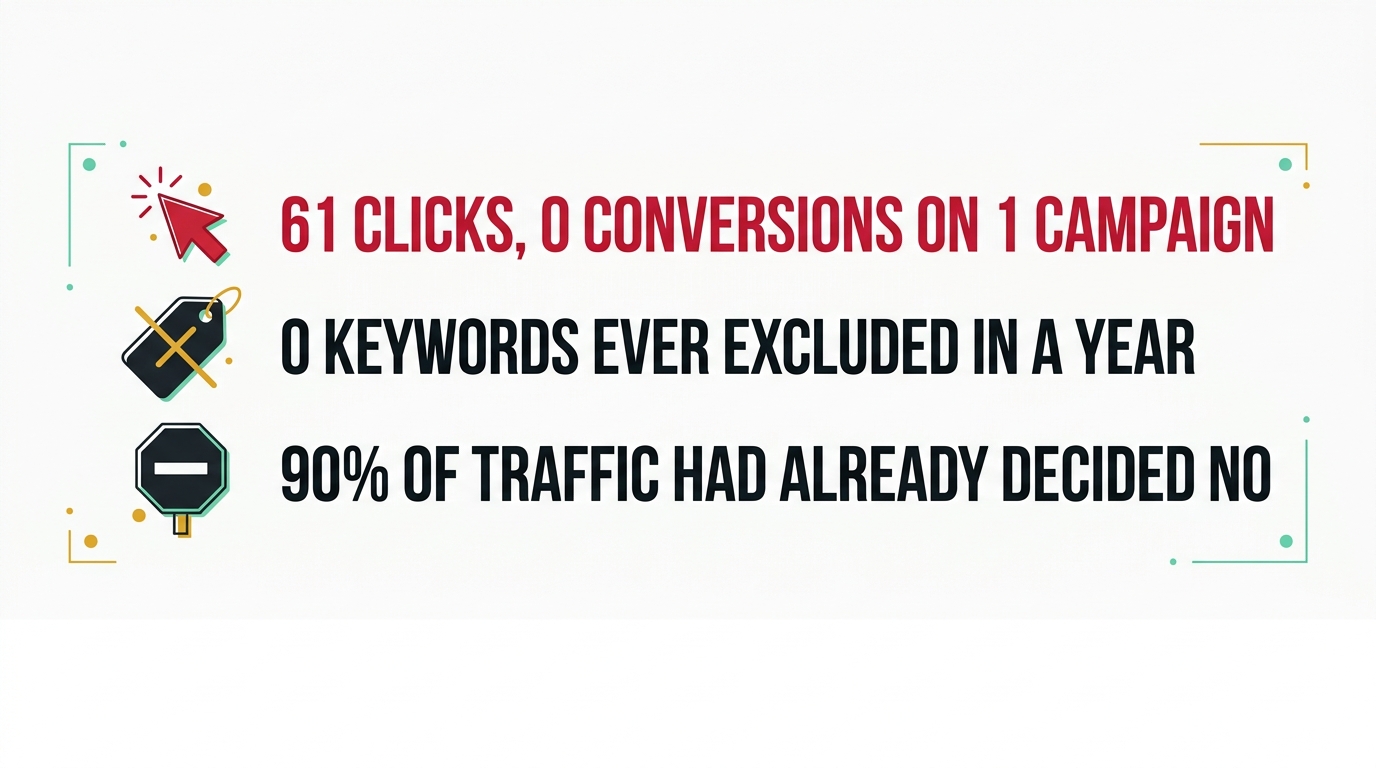
One campaign had earned 61 clicks and 0 conversions across the whole year. It was still set to maximise conversions.
It gets worse. Once I actually read the search terms report, 90% of the traffic that account had ever paid for had already decided it wasn’t going to become a patient.
Not 1 of those clicks had ever been marked as excluded.
Why 1 ad group for every service means Google can’t tell any of them apart
Inside the account there was a single ad group. It was named “Ad Group 1.”
Every service the clinic offered was sitting inside it together: a specific named technique, general foot pain, a pregnancy-related service, and a handful of others besides.
An ad can speak to one of those people at a time, not all of them. Thrown into 1 bucket, the account could only ever write something vague enough to half-fit everyone, which in practice fits nobody particularly well.
Why an account with 0 negative keywords invites everything in
Nobody had added a single negative keyword, ever. The “excluded” column was empty from the first day of the account’s life.
So the account had spent a year bidding on the names of competing clinics. On other doctors’ names entirely, people searching for someone they already had an appointment with.
It had also been bidding on symptom questions from people still doing research, not booking anything. On massage and acupuncture searches that share some of the same vocabulary but want something else completely.
Tell Google nothing is off limits, and it will bring you everything. 90% of this account’s traffic had already told you, in the words it searched, that it wasn’t coming in.

Why nobody had worked out what a lead was actually worth
Here’s the part that made the wasted 90% sting more. Nobody had ever sat down and worked out what a new patient was actually worth to this clinic.
A rough rule of thumb: if a patient is worth $3,000 to the business over time, a competitor in that space would typically be happy paying around $300 to bring that patient in.
This account had never been given a budget built around that kind of number. It had just been handed a flat monthly spend and left to find whatever it could, which is exactly how an unsorted ad group ends up competing with a properly priced one for the same clicks.
How to check your own account for this
- Open your ad groups and read their names. If any of them is still called “Ad Group 1” or anything equally generic, that’s a sign nobody has gone back in to organise it since the account was first built.
- Count how many different services share 1 ad group. If a sciatica search and a pregnancy-related search and your clinic’s own branded technique are all sitting together, no single ad can speak properly to any of them.
Signs your agency has never actually gone back in
- Check the size of your negative keyword list. An account that’s been properly managed for a year should have hundreds of excluded terms, not 0. A list that size, after 12 months, means nobody has looked at the search terms report since launch.
- Search your own clinic’s name and a close competitor’s name inside the keywords tab. If either shows up with no negative sitting against it, the account is paying to compete with the wrong search, or paying for people who already know exactly where they’re going.
The bigger point
Nobody mismanaged this account out of carelessness. It was simply never organised in the first place, and an account that’s never sorted drifts towards taking in whatever is cheapest to catch.
That’s the part a PPC consultant should catch inside the first hour, not the first year. It isn’t about 1 bad decision. It’s a whole account built without the basic filing that every other one of these needs.
Negative keywords are not an advanced technique you add once the basics are sorted. They are the basics. Same with separating every product or every service into its own space to work with, rather than 1 shared folder trying to speak for all of them at once.
None of this needed a bigger budget or a cleverer bidding strategy. It needed somebody to open the search terms report and actually read it, properly, once.
If you want an honest read on what your own account has actually been bidding on, the audit checklist covers where to look first. You know where I am.
A few questions I get asked
Is it normal for a Google Ads account to have hundreds of negative keywords? Yes, for any account that’s been running a year or more. Negatives build up week by week as the search terms report reveals what to exclude. If yours has a handful, or 0, it hasn’t been maintained.
Can 1 ad group ever be the right call? Only when every keyword inside it shares the same intent. The test is whether 1 single ad could honestly speak to everyone who might type any of those words in.
How do I find out what my own account has actually been matching against? Open the search terms report, set it to the full life of the account, and read every unique phrase. It takes an hour and it tells you more than any dashboard summary will.
Does a bigger budget fix an account like this? No. More money spent against the same unsorted list just finds the waste faster, and finds it with a bigger bill attached.
2 ways I can help you get this right
If you want to know what your own account has actually been bidding on, book a free call and we’ll go through it together.
If you’d rather learn to spot this yourself before the next agency hands you a dashboard, my masterclass How to Overtake Your Top Google Ads Competitors in 8 Weeks walks through exactly that.

Claire Jarrett
Google Ads consultant since 2007, published author (6 books), and Google Partner. Claire was the first person to launch Google Ads training in Europe and has helped thousands of professional service businesses scale their leads.
More about Claire