$5,200 a Month, and They Told Him Not to Look Inside His Own Account

I had a call recently with the co-owners of a garage door and gate franchise, about 3 months into the business. They’d been paying an agency $5,200 a month to run their ads and their local listing together.
Neither of them had ever logged into the Google Ads account. Not once.
When they’d asked about it early on, the agency told them it was better not to have too many hands in there. So they left it alone, and paid the bill every month instead.
Why “don’t get too many hands in it” should worry you
There’s a real, boring reason agencies sometimes discourage clients from looking at their own account: it’s simpler to manage without someone asking questions mid-month.
There’s a less boring reason too. Google’s own partner terms say the account belongs to the advertiser, not the agency. An owner who’s never inside it has no way of checking that’s actually true.
It’s not always a power grab. Sometimes it’s just easier for everyone if the client stays out. But easier for the agency is not the same as good for the business.
They didn’t push it a second time. Most people wouldn’t, especially when the person telling them no sounds confident and is answering the phone every time they call.
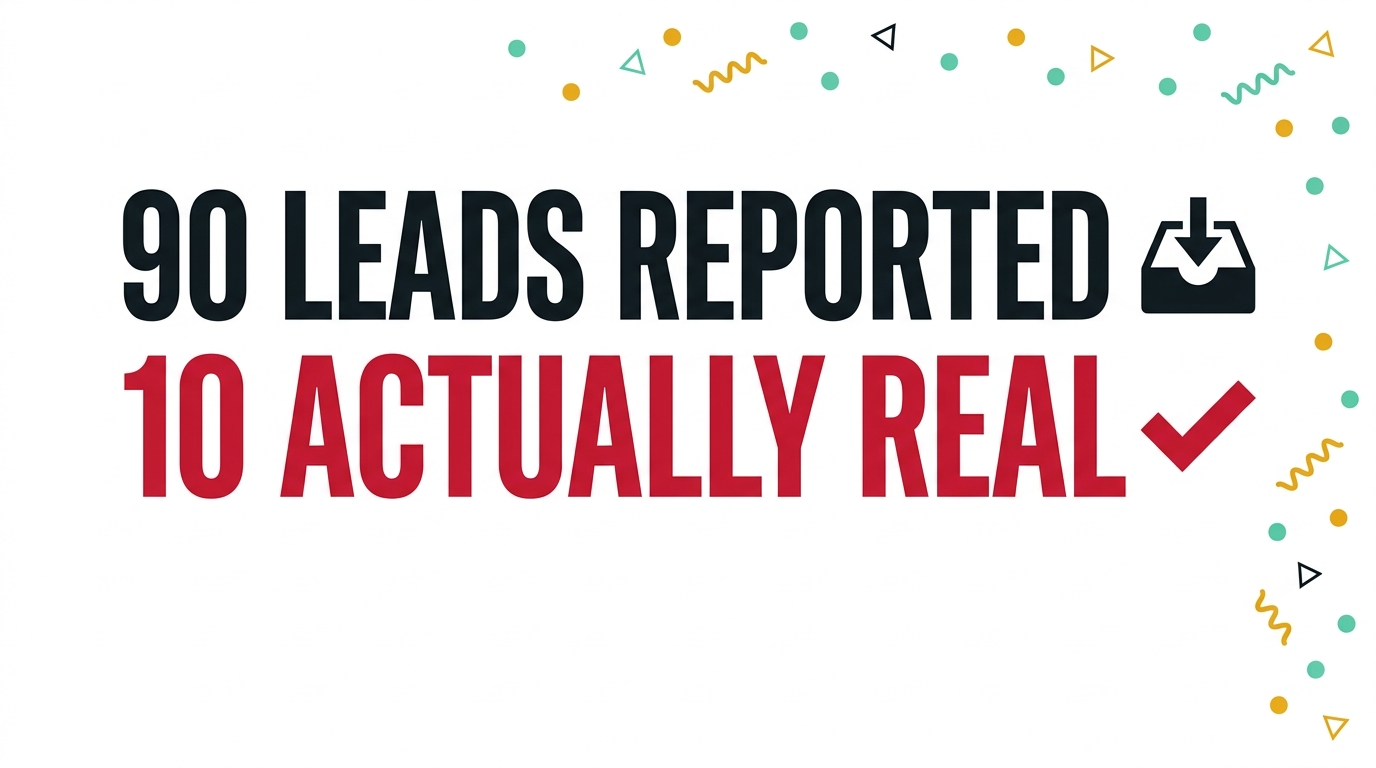
A hundred leads and 10 of them real is not a lead problem. It’s a definition problem.
What “100 leads” turned out to mean
Once they finally got a look inside, the monthly report showed roughly 90 leads. Every one of them counted the same way, scored 100% match by the platform’s own system.
The real number of usable enquiries, the kind that could actually book a job, was closer to 10. The rest were people asking about a fence repair, a locksmith, even a septic tank pumped, none of it anything a garage door company does.
That happens when a campaign is set to chase volume above everything else, with search partners and broad categories left switched on. The system will happily count a click as a lead regardless of what the person actually wanted.
Nobody had gone back through those 90 and marked which ones turned into a real job. Without that step, the report just keeps repeating the same inflated number every month, and it looks fine until someone finally checks.
Why the end of the month is always the expensive part
They’d noticed something else too. Every time they paused spending for a slow week and switched it back on, the account would blow through $1,800 in a single day.
That’s what happens when a monthly budget target is behind schedule. The pacing system has a number it’s trying to hit by the end of the month, and it will spend faster to get there, whatever the quality of what it’s buying that day.
Left alone, with nobody watching, that’s a quiet way to burn through a budget fast, on exactly the kind of leads described above.
Neither owner had ever seen this happen in real time. They only knew the money had gone, days after it was already spent.
How to check your own account for this
- Log into Google Ads yourself and check Admin, then Access and Security. Confirm your own email is listed with Admin access, not just as a standard user watching from the outside.
- Ask for the lead scoring definition in plain writing. A 100% match score should mean something specific, not just that somebody clicked.
- Pull the search terms report for the last 90 days. Anything clearly outside what you sell belongs on a negative list, not counted in your results.
- Ask what happens to your budget in the last few days of the month. If nobody can answer that plainly, that’s your answer.
What to ask before you sign with anyone
- Ask how many negative keywords are in the account today, and how often that list gets added to. A number that never moves means nobody’s tending it.
- Ask to see the change history for the last 90 days. An account nobody touches is telling you something, whatever the invoice says.
- Ask directly whether you’ll have your own login from day 1. Any hesitation here is the whole answer.
- Ask how a lead gets counted, and whether that number ever gets checked against real bookings.
The bigger point
Neither owner had done anything wrong here. They trusted the people they were paying, and assumed a bigger company answering the phone meant a safer pair of hands.
That trust is exactly what let 3 months of invoices go unquestioned. The wrong keywords and an untouched account both hide behind the same thing: nobody from the business ever looked.
A management fee on its own tells you nothing about what’s happening inside the account it’s paying for. The only way to know is to be let in, or to insist on it.
You’re allowed inside your own account. If an agency tells you otherwise, ask them why, in writing. If you’d like a Google Ads consultant to check what’s actually happening in yours, you know where I am.
A few questions I get asked
Is it normal for an agency to manage the account without giving me access? No. You should always have your own Admin login, even if you never touch it day to day. If an agency resists that, ask why directly, and treat a vague answer as a real one.
How do I know if my “leads” are genuine? Check what the conversion action is actually measuring, then compare it against real bookings for a month. If 56 leads turn into 4, the account is measuring the wrong thing, not underperforming.
Why would spending speed up near the end of the month? Because most campaigns run on a monthly budget target, and the system will spend faster to hit it if it’s behind. That’s a pacing decision, not a sign more people suddenly want what you sell.
What if I built my own account with AI and never had an agency at all? Check it anyway. A cheap or AI-built account leaves the same defaults switched on that a careless agency does. Nobody’s watching either way unless you are.
2 ways I can help you get this right
If you’d like a second pair of eyes on your account, book a free call and I’ll tell you plainly what I find.
Or if you’d rather work through it at your own pace, my masterclass, How to Overtake Your Top Google Ads Competitors in 8 Weeks, walks through exactly this kind of check, one step at a time.

Claire Jarrett
Google Ads consultant since 2007, published author (6 books), and Google Partner. Claire was the first person to launch Google Ads training in Europe and has helped thousands of professional service businesses scale their leads.
More about Claire