A New Campaign Went Live Next to the Old One. Sales Went From $32,000 to $0.
I audited an account recently for the owner of an online business that sells professional certification courses. A new agency had taken the account over in June, and the week their campaign went live, sales from Google Ads dropped from $32,000 a month to $0.
Not slower. Not down 20%. $0. The owner asked them what had happened. They could not tell him. He asked them how to undo it. They could not tell him that either.
Why running a new campaign next to the old one is never a test
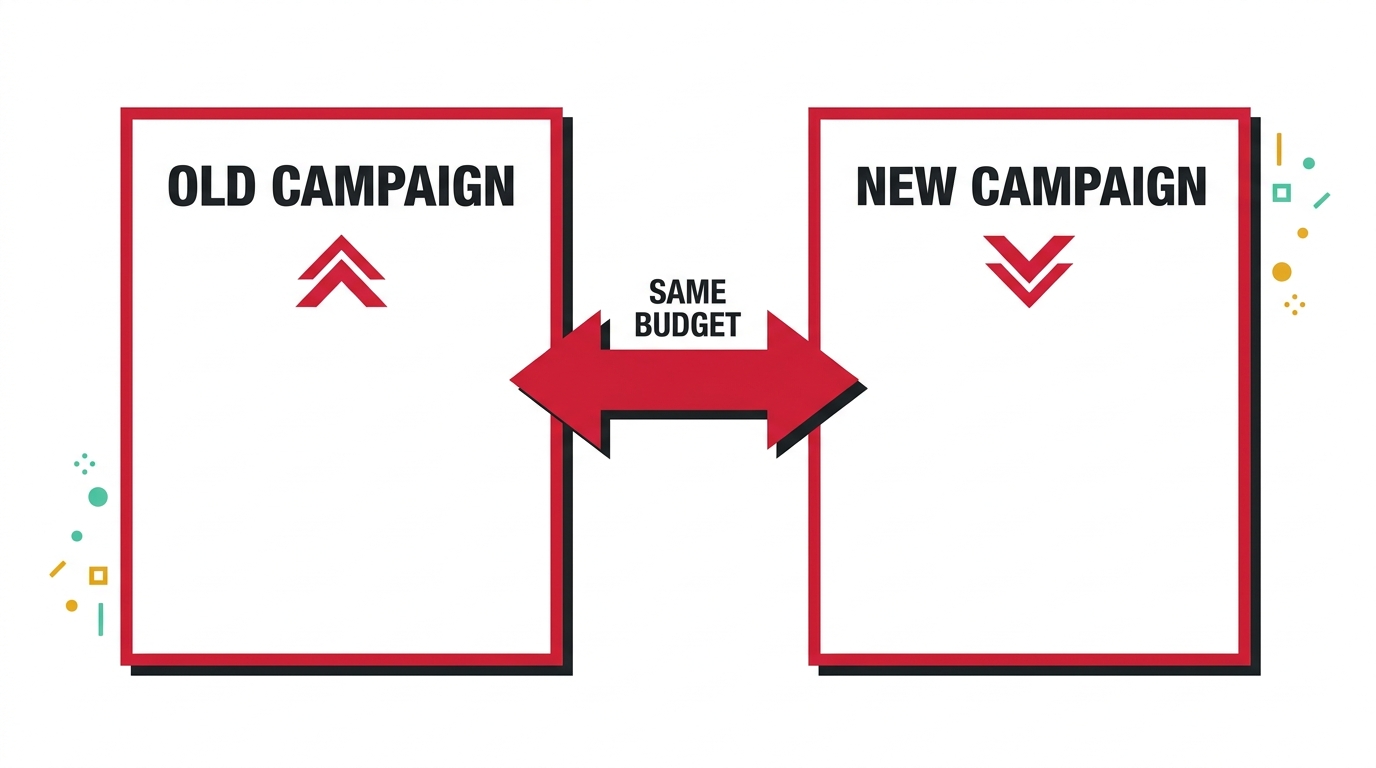
When you want to try a different approach in an account, the instinct is often to build the new version and launch it alongside what’s already working, so you can compare them. Google Ads does not run 2 campaigns in a vacuum. They compete for the same auctions, the same budget signals, and very often the same searches. Left running together, the new campaign is never tested against a clean baseline. It is tested against a campaign it is actively taking budget and impressions from, and vice versa. Within weeks, neither number means anything at all.
That is exactly what had happened here. The previous agency had left the old campaign, the one bringing in $32,000 a month, running untouched, and launched a brand new one right alongside it, bidding on many of the same terms. Within a month the old campaign had collapsed, and the new one had not replaced it with anything. This was never 2 approaches being tested against each other. It was 2 campaigns fighting over the same budget, and losing together.
How a broken pixel quietly changes what you’re paying for
Alongside the campaign collision, there was a second problem nobody had caught. Sometime that same month, the tracking that told Google when someone had actually bought a course quietly stopped firing correctly. Google did not know that. It kept optimising exactly as instructed, just against a different number. Instead of hunting for people who completed a purchase, it started hunting for people who had merely begun the checkout process and never finished it. In the 30 days after launch, 16 people started checking out. 7 of them actually bought anything. Google had been told those 16 were the goal.
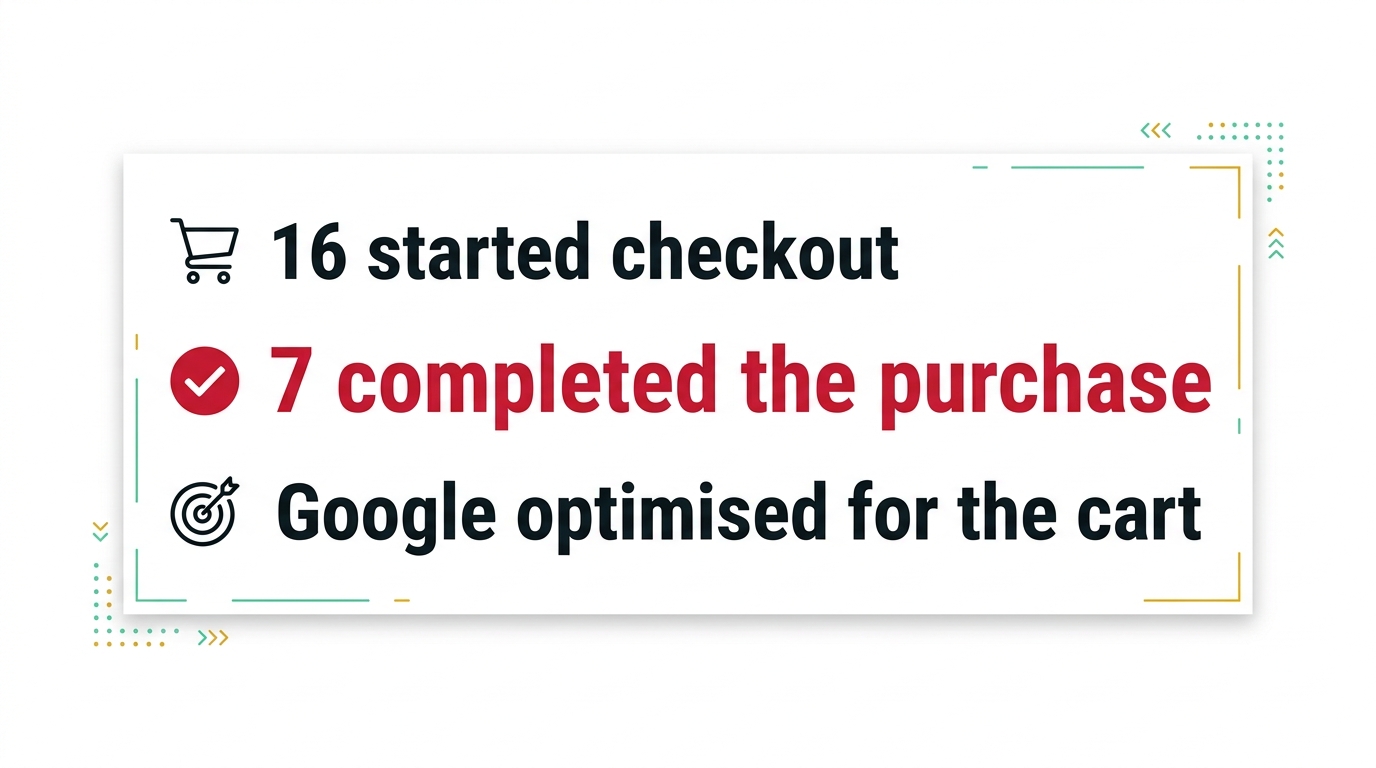
Bidding platforms are relentlessly literal. They cannot tell the difference between a genuine sale and someone abandoning a shopping cart unless you tell them, explicitly, which one is the one that pays the bills. Tell it to chase carts, and it will hand you carts, and report the campaign as working while it does it.
I would never let a new campaign run next to one that was already working. You do not get a test out of that. You get 2 campaigns fighting over the same money, and neither one tells you anything true.
How to check your own account isn’t doing this
- Find out if a new campaign has ever launched while an older one kept running. Open both in the same date range and compare the actual search terms each one is showing against. If they overlap by more than a handful of keywords, they are competing with each other, not testing anything.
- Open your conversion actions and check what is actually being counted. Click into the conversion action itself, not just the total on the dashboard, and read the event it fires on. “Started checkout” and “purchase completed” are 2 very different signals to hand a bidding algorithm, and only one of them pays your bills. It’s the same trap behind a dashboard’s fake leads that were never real enquiries at all.
What a genuinely clean test actually looks like
- Pause the old campaign, or leave it completely alone. If you want to know whether a new approach works, you need 1 clean baseline to measure it against, not 2 live campaigns quietly taking data from each other.
- Check the result within days, not months. A campaign that has silently switched to optimising against the wrong signal will show it within the first week, provided somebody is watching the actual conversion events and not just the headline number on the dashboard. This is exactly the kind of thing the ultimate PPC audit checklist is built to catch before it costs you a month of spend.
The bigger point
Nobody sets out to run 2 campaigns against each other, or to let a bidding algorithm quietly start chasing the wrong signal. It happens because a change gets made with good intentions, the account keeps reporting numbers, and nobody goes back to check what those numbers actually represent until the sales have already gone quiet. The business I audited had not done anything obviously wrong. The account had just been teaching Google to chase the wrong outcome, and Google had learned the lesson perfectly.
An agency taking over an account and immediately changing what is running is also exactly the kind of moment worth double checking who has control of the account itself, not just what campaigns are live inside it.
If a campaign change in your own account happened around the same time results started sliding, that is worth 10 minutes this week, before it costs you another month. If you would like a second pair of eyes on it, whether that is a full audit or a conversation with a PPC consultant who will actually open the conversion actions rather than just read the dashboard, that is exactly what I am here for. You know where I am.
A few questions I get asked
How long does it take a broken conversion pixel to wreck an account? Sometimes just weeks. Automated bidding reacts to whatever signal you give it almost immediately, so if that signal quietly changes from a sale to a cart abandonment, the account starts chasing the wrong outcome from that point, not just from whenever someone finally notices.
Is it ever safe to run 2 campaigns on the same product at once? Only if they are targeting genuinely different searches or audiences with minimal overlap. If both are bidding on similar terms for the same thing, you have 1 budget being split between 2 competitors, and you will learn nothing from either.
Why didn’t Google warn anyone the tracking had broken? It does not know. Google Ads reports whatever event you told it to count as a conversion. If that event quietly stops meaning “a sale happened,” nothing in the interface flags that. It just keeps optimising, confidently, for a number that no longer means what everyone assumes it means.
Can an account like this recover? Usually, yes, once the conflicting campaigns are separated and the tracking is fixed and rebuilt on real data. It will not happen overnight, because Google needs to relearn on clean information, but it is rarely as broken as it looks the week the numbers go to $0.
2 ways I can help you get this right
If you’d like a free strategy call to talk through your account, book one here.
If you’d rather learn the process yourself first, my masterclass, How to Overtake Your Top Google Ads Competitors in 8 Weeks, walks through exactly this.

Claire Jarrett
Google Ads consultant since 2007, published author (6 books), and Google Partner. Claire was the first person to launch Google Ads training in Europe and has helped thousands of professional service businesses scale their leads.
More about Claire