95 of 450 Bookings Never Touched the Phone, and Some Came In Overnight
On an onboarding call with the owner of a moving company, I asked the question I ask every new client: what time of day do you want the ads on?
I already had a guess. His phones are answered between set hours, so I assumed we would run the ads between set hours too.
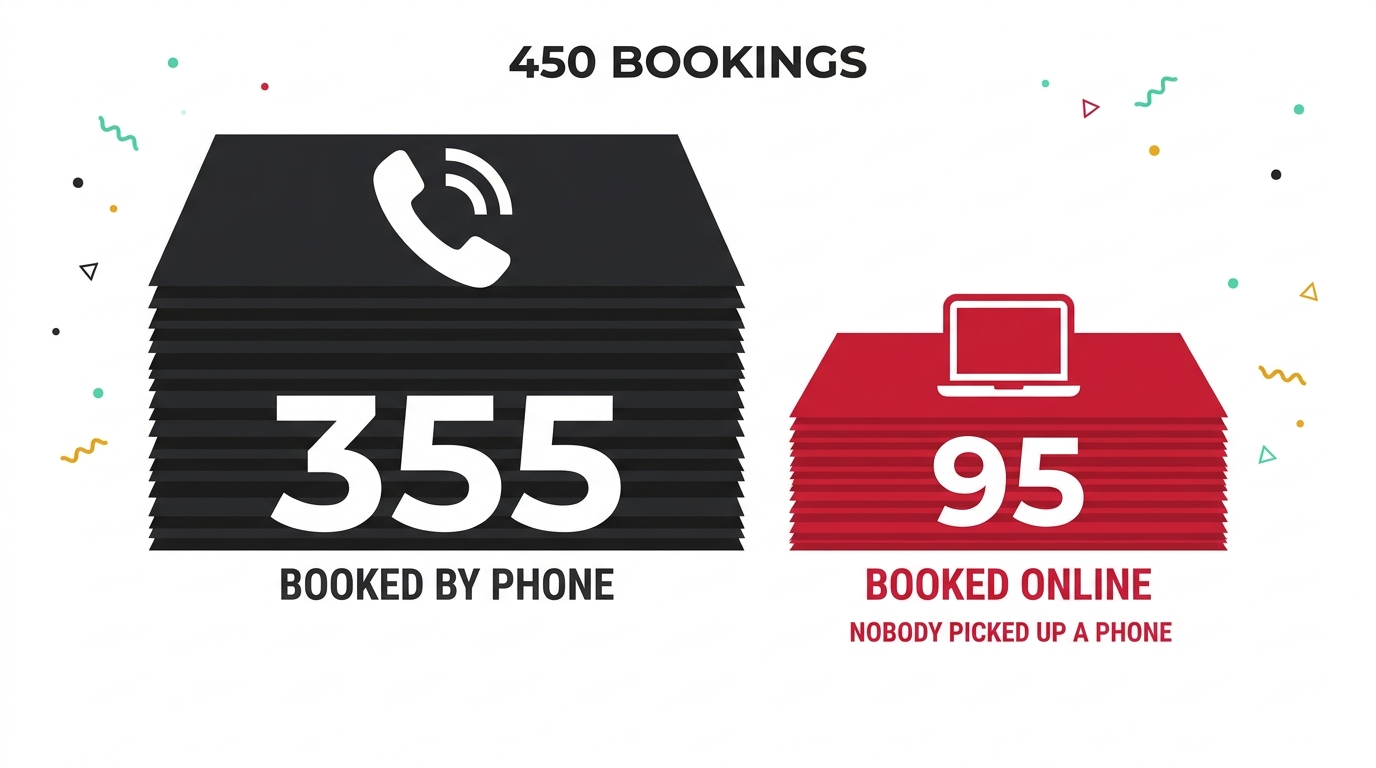
Then I asked 1 more question, and his answer changed mine. So far this year, 95 people had booked online out of 450 jobs. That is about 1 in 5 customers who never spoke to anybody.
Why switching ads off outside phone hours feels so sensible
Some of my clients only want their ads on between 8 and 6, Monday to Saturday. If somebody rings and gets an answerphone, that is a lead lost.
I understand the instinct. This owner told me his customers make the decision on the phone.
They are usually in the middle of buying or selling a home, and they ring a short list of removal companies. Once his team loses them off the phone, they are probably not going to book.
That is a fair thing to build around. His own team answers from 8am to 5pm, and a call centre takes over from 5pm to 11pm, Monday to Friday.
At weekends the phones are covered from 10am to 6pm on Saturday and Sunday.
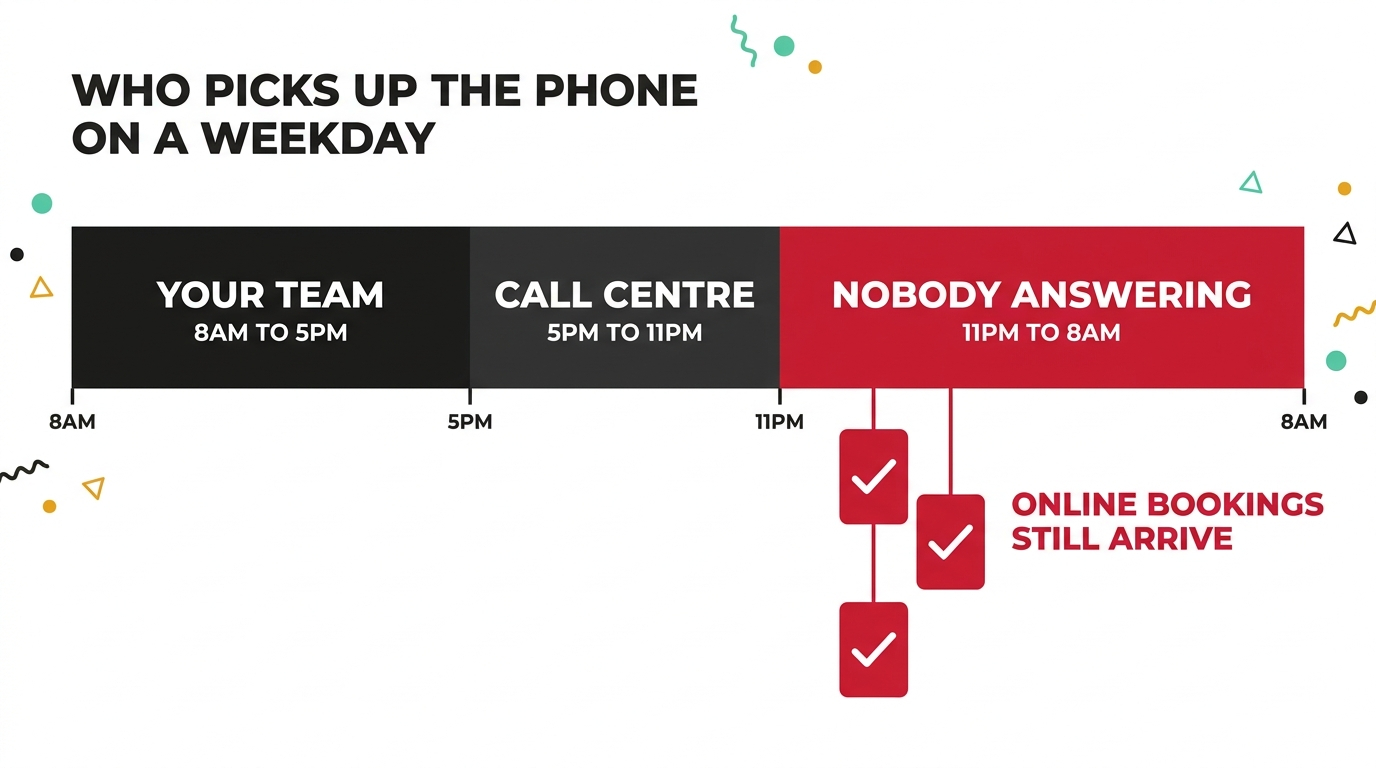
On weekdays, that leaves 11pm to 8am with nobody answering. My first instinct was to advertise in the covered hours and leave the rest switched off.
Why I changed my answer on the spot
Before I wrote that down, I asked how often people leave a web form, or some other kind of enquiry, and go on to book.
He had only just started online booking. A customer goes to the website, picks a day and a time, and builds their own package without speaking to anyone.
He pulled up the figures while we talked. Of 450 jobs so far this year, 95 had been booked that way.
So I changed my answer there and then. I told him to run the ads 24 hours a day, 7 days a week.
Most of the accounts I run are on 24/7 anyway. The phone-hours instinct is the exception, and it only holds when the phone is the only door.
Why people book at the hours your phone is off
He explained it better than I could. When you are buying a house, you are often up late at night, excited, and you want to get it sorted.
He could see the times those online customers booked. He didn’t have the figures with him, but he told me there are people booking overnight.
I can’t give you a count of those overnight bookings, because he didn’t have one to hand. What matters is that they exist at all.
Why an ad schedule cuts off the searcher, not the search
The ad schedule is a setting that tells Google when your ads may show. It does nothing to the searches themselves.
People still search late at night. All the schedule decides is whether you are in the auction when they do.
Switching your ads off at night doesn’t stop people searching. It hands them to whoever stayed on.
They see somebody else’s ad, and somebody else’s booking page. If that page lets them book there and then, you never find out you were in the running.
This is not an argument for 24/7 on every account. If the phone really is the only way to book, I would still limit the hours.
Paying for clicks that land on an answerphone is a real cost. The question I’d ask first is whether there is any other door.
Why a small budget isn’t the reason to cut hours
His budget is $2,500 a month, which works out at about $80 a day. That sits across 5 campaigns: 3 area campaigns, a small brand campaign at about $10 a day, and a small test on competitor names at $10 to $20 a day.
The brand campaign is there because competitors might bid on your name, so you need to be there when someone searches for you.
A daily budget is a cap, not a clock. Running 24 hours doesn’t mean spending more. It means Google can spend the same money across more of the day, and I can see where it works.
With a budget that size, I would not want to guess. I’d run it wide first, then let the data show which hours earn their place.
A small budget needs watching closely either way, because 1 broad keyword can eat it.
How to check your own account for this
- Open the hour-of-day and day-of-week reports. Look at conversions as well as clicks, across several weeks. A single quiet night tells you nothing.
- Look at your ad schedule setting. Many accounts have hours someone set years ago, and nobody remembers why.
- Find the timestamps on your online bookings and forms. If they arrive when your phones are off, your schedule is hiding customers from you.
- Check that online bookings are counted as conversions. If they aren’t, Google can’t learn from them. I wrote about wrong conversion goals and what the algorithm does with them.
- Check you can tell where each booking came from. Enquiries nobody could trace make every schedule decision a guess.
Tracking matters even more once you run all day. If it quietly stops, as it did in the plugin story, you won’t see it in the night hours.
What can catch the hours nobody answers
- Online booking. The customer picks a day and time themselves. It works while your team sleeps.
- A form or a call-back request. Not every customer wants to book on the spot, and a form lets them leave their details instead.
The bigger point
The owner wasn’t wrong to protect the phone. It is where most of his customers decide.
But his own numbers showed a second door, and that door was open all night. The instinct to run ads only while someone can answer would have switched off exactly the hours when some of his customers were awake and ready.
A good Google Ads consultant should ask what happens when the phone isn’t answered, before agreeing any schedule.
If you’d like to see what your own account is doing through the night, the audit checklist shows where to look first. You know where I am.
A few questions I get asked
Should I run ads 24/7 if the phone is my only way to book? Usually not. I’d limit the hours to when somebody can answer, because a click that reaches an answerphone is money spent on a lead you probably lose.
How do I find which hours bring bookings? Use the hour-of-day and day-of-week reports in Google Ads, and look at conversions across several weeks. I’d trim hours only when they show nothing over a fair stretch of time.
Does running 24 hours a day mean spending more? No. Your daily budget is the cap, and the schedule only decides when the money can be spent. Running all day spreads the same budget across more hours.
Can an AI receptionist replace my phone team? I wouldn’t use it that way. I’d use it for the hours nobody answers, and keep people on the calls where a customer is deciding between a short list of companies. I go into this in AI and Google Ads.
2 ways I can help you get this right
If you want to know where your own ad budget is really going, book a free call and we’ll go through it together.
If you’d rather learn to spot this yourself, my masterclass How to Overtake Your Top Google Ads Competitors in 8 Weeks walks through exactly that.

Claire Jarrett
Google Ads consultant since 2007, published author (6 books), and Google Partner. Claire was the first person to launch Google Ads training in Europe and has helped thousands of professional service businesses scale their leads.
More about Claire