A $60 Client From a Directory Made Google Ads Look Broken
I had a call recently with a couple who run a wedding and events florist business. They had tried Google Ads, and they were close to giving up on it.
They’d spent thousands of dollars over time. They had never booked a single client from it. Not 1.
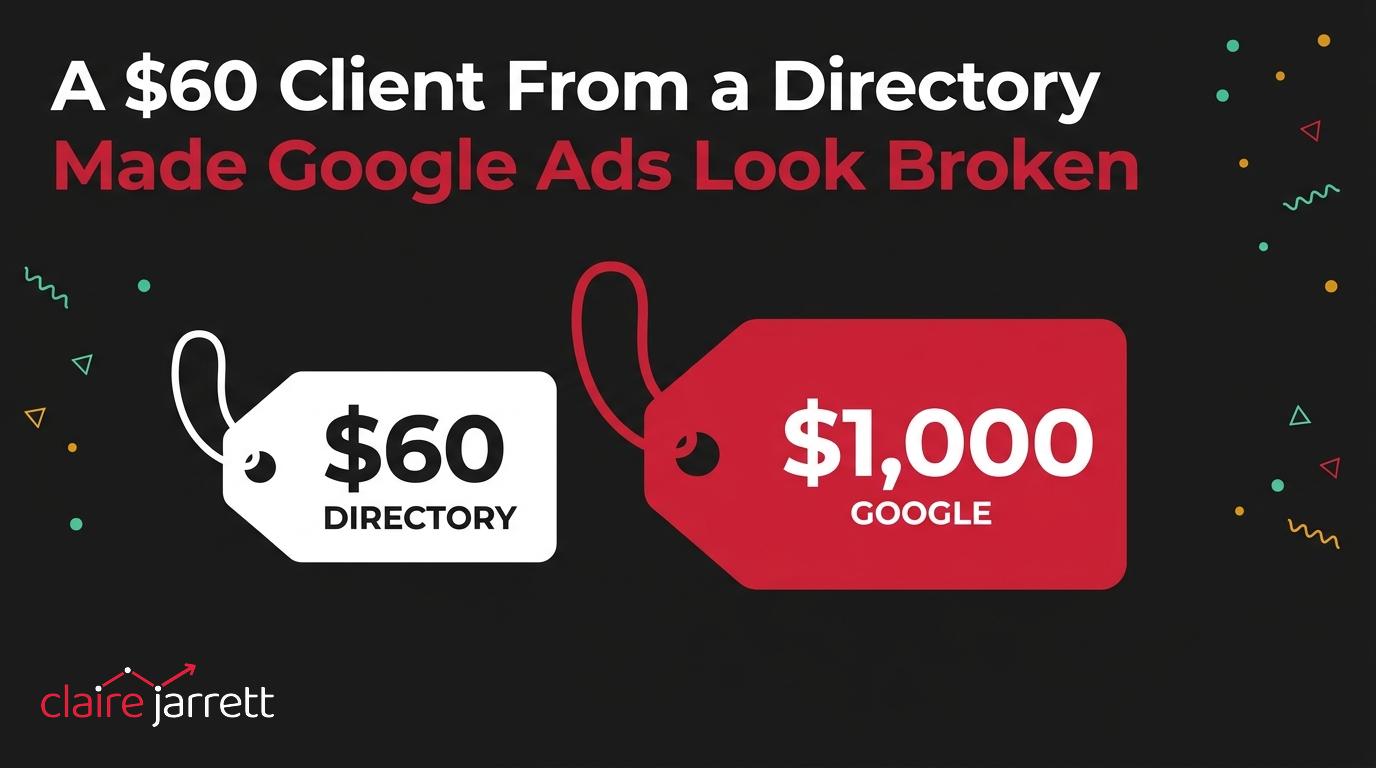
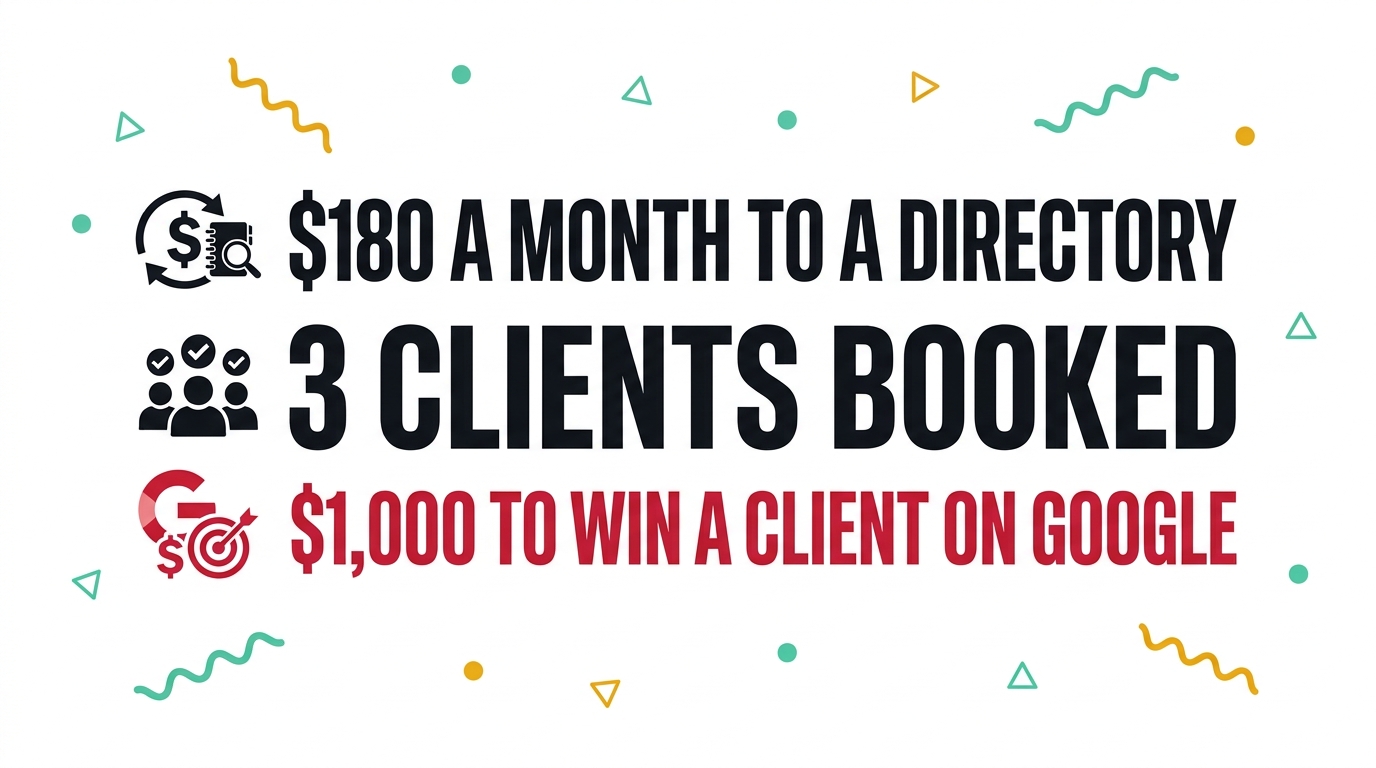
Meanwhile, they were paying $180 a month to a wedding directory and getting 7 to 9 qualified enquiries from it. Around 3 of those turned into booked clients.
Why a $60 client makes every Google test look like a failure
Do that maths and the directory costs them about $60 for each booked client. Their packages sell for $3,500 to $6,500. It’s a brilliant return, and I told them so.
But it quietly became the yardstick for everything else. Every Google test was judged against $60. Nothing on Google was ever going to look like that, so every test looked like a fault.
A flat-fee directory told them what a client costs. Google was always going to quote a different price, and they read it as a fault.
The directory doesn’t run an auction. It’s a fixed monthly fee for a fixed listing. That’s part of why it’s so cheap.
Google is an auction. Your competitors are paying for the same couple, and the price is whatever they’re willing to pay. So the question is never “why isn’t Google as cheap as the directory”. It’s “what are my competitors prepared to pay for this client, and can I afford to enter?”
What a $1 click is actually buying
They had tested at $10 a day and at $100 a day. They had run Search, and they had run Performance Max. They’d got clicks, but they were sure the clicks were bogus.
They were probably right. If you aim for $1 and $2 clicks, you are aiming at the people Google can find most cheaply. And the cheapest people to find are the ones still browsing.
Couples who’ve just got engaged and are collecting ideas, looking at styles and venues. They’re the same crowd they had met at wedding fairs and called a waste of time.
Here’s the part that gets uncomfortable. I’d rather have 10 clicks at $10 each, where 1 becomes an enquiry, than 100 clicks at $1 that all go nowhere. 1 enquiry at $100 is a real lead. 100 clicks at $1 is a bill.
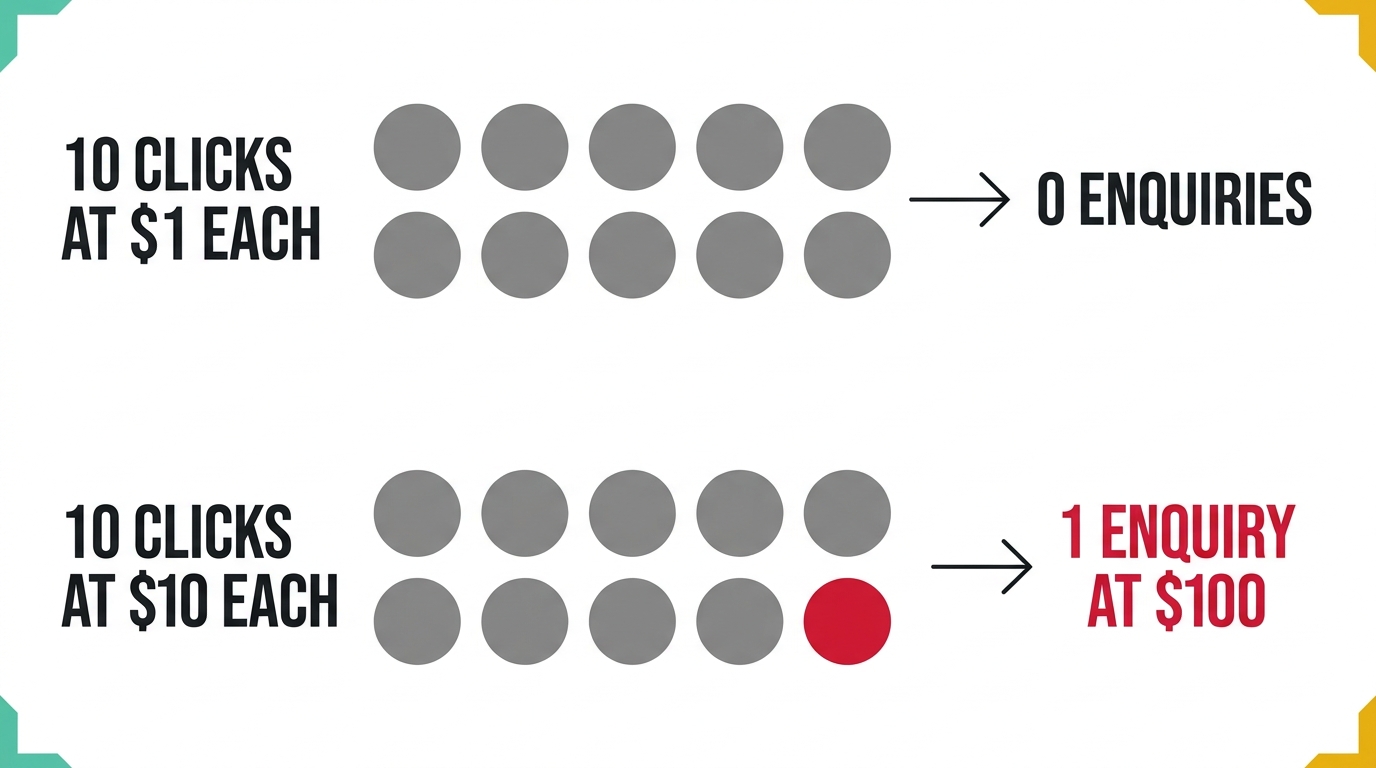
On a quiet budget it feels frightening, because the clicks start costing $10 each and the first 20 can go by with nothing. That’s exactly when most people switch it off and decide it doesn’t work. It’s the same reason small budget tests can’t give a clean result.
Why 4 calls with Google and a chatbot did not fix it
They had been on 4 calls with Google’s own representatives. After each one, they pasted the advice into an AI chatbot, and each time it told them not to follow it.
I understand why. They were stuck between 2 sources of advice that disagreed.
I use AI every day, including in my AI consulting work, and I haven’t perfected building campaigns with it. If I haven’t, I don’t think a small business owner can yet. I’ve written about using AI for ads, and the short answer is not on its own.
What was missing was a number, not an opinion. What does a qualified lead cost in this market, and how many become clients? Without that, every test is a guess dressed up as an experiment.
How to work out what Google would cost you
- Start with what a client is worth, then how many enquiries become one. If 1 in 10 enquiries books, and an enquiry costs about $100, then a client costs about $1,000. Compare that with a $3,500 package, not with a $60 directory fee.
- Look at who is already advertising. Their keywords and ads are visible, and they show what your competitors are prepared to pay to win the same client.
- Set the test budget to the target, not the other way round. To get 20 enquiries a month at $100 each, you need around $2,000 a month. A much smaller budget cannot give you a result either way.
Signs you’ve been using the wrong yardstick
- You’re comparing Google to a source that charges a flat fee. Flat-fee directories don’t have an auction. Their cost per client tells you nothing about Google’s.
- Your best click is the cheapest one. If your account celebrates $1 clicks and has 0 booked clients, it has found the people least likely to book.
- Nobody has written down the cost of an enquiry that’s acceptable. Without that number, you can’t tell a failed test from a test that never had enough budget.
The bigger point
Nothing here was a lack of trying. These 2 had tested different budgets and campaign types, and had sat through 4 calls with Google. What they hadn’t had was the price of a client on Google, so every result was read against the wrong number.
That is where a Google Ads consultant earns the fee. It’s less about ad copy and more about working out what the market charges and whether the numbers can work, before spending another dollar.
It connects to my view on rising cost per click. Cheap clicks feel like winning. They are usually the people who were never going to book.
The same question comes up in a client’s real worth, where an average cost per lead hid the number that mattered. And it’s close to the expected conversion rate problem: judge the account against the wrong number and it always looks broken.
If you want to see what your own account is really doing, the audit checklist is the place to start. You know where I am.
A few questions I get asked
Is Google Ads worth it if a directory already gives me clients at $60 each? Keep the directory while you test, because it’s excellent value. Google will cost more per client, and whether that’s worth it depends on what a client is worth to you.
Why are my Google clicks so cheap but I get no enquiries? Cheap clicks usually come from people who are researching, not buying. They type short, broad searches and haven’t decided who to book. Narrower searches cost more per click and send fewer, better people.
How much should I budget to test Google Ads properly? Work backwards from the enquiries you want. If you need 20 a month and each costs about $100, that’s around $2,000. A much smaller budget can’t tell you whether it works.
Should I follow the advice from a Google representative? Check any advice, from Google or anyone else, against your own cost per enquiry and what a client is worth before you change anything.
2 ways I can help you get this right
If you want to know what a client would really cost you on Google, book a free call and we’ll go through your numbers together.
If you’d rather learn to work it out yourself before you spend more, my masterclass How to Overtake Your Top Google Ads Competitors in 8 Weeks walks through exactly that.

Claire Jarrett
Google Ads consultant since 2007, published author (6 books), and Google Partner. Claire was the first person to launch Google Ads training in Europe and has helped thousands of professional service businesses scale their leads.
More about Claire