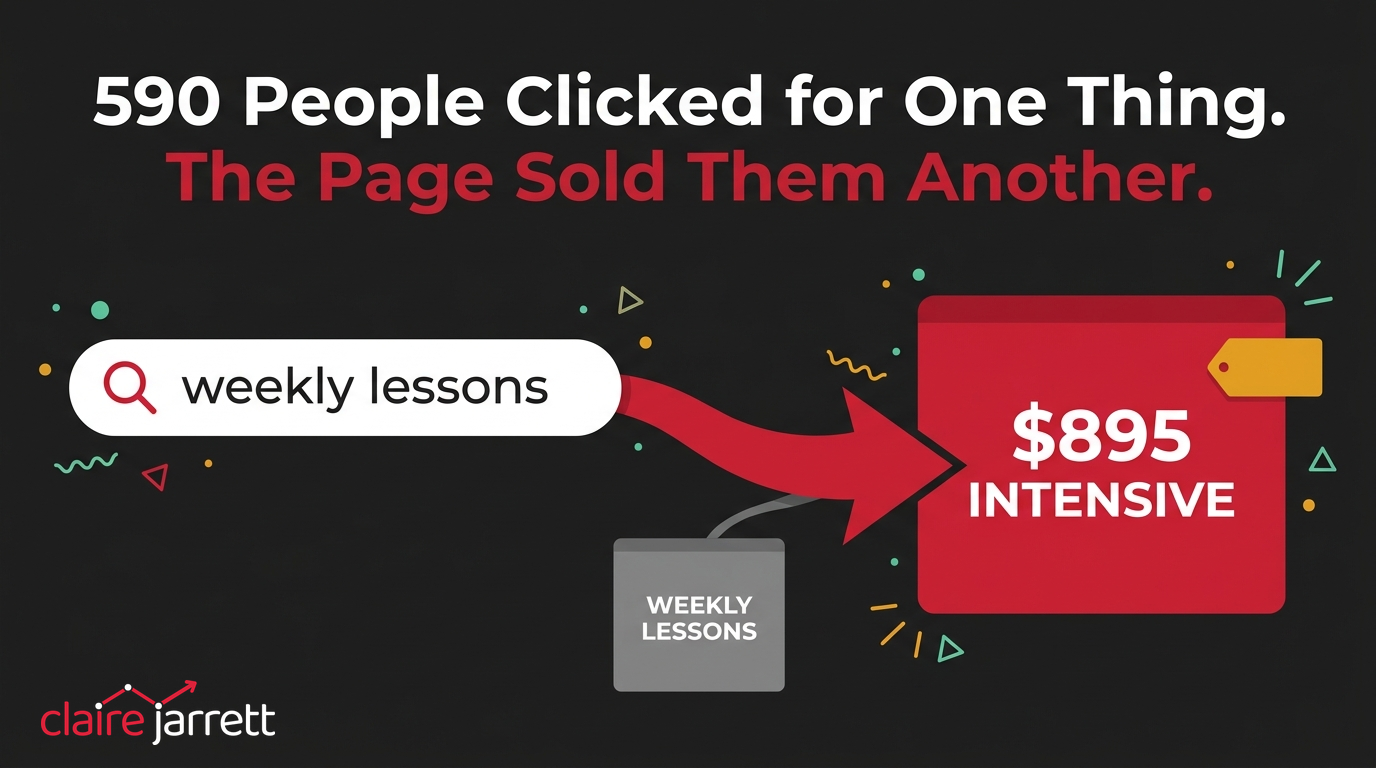
590 People Clicked for One Thing. The Page Sold Them Another.
I audited an account recently for the owner of a swimming lesson franchise that runs instructors across several towns, each holding its own small daily budget.
One town was spending $18 a day. That’s a tight budget to be making mistakes with, the same way a $25 daily budget elsewhere couldn’t absorb a single wrong turn.
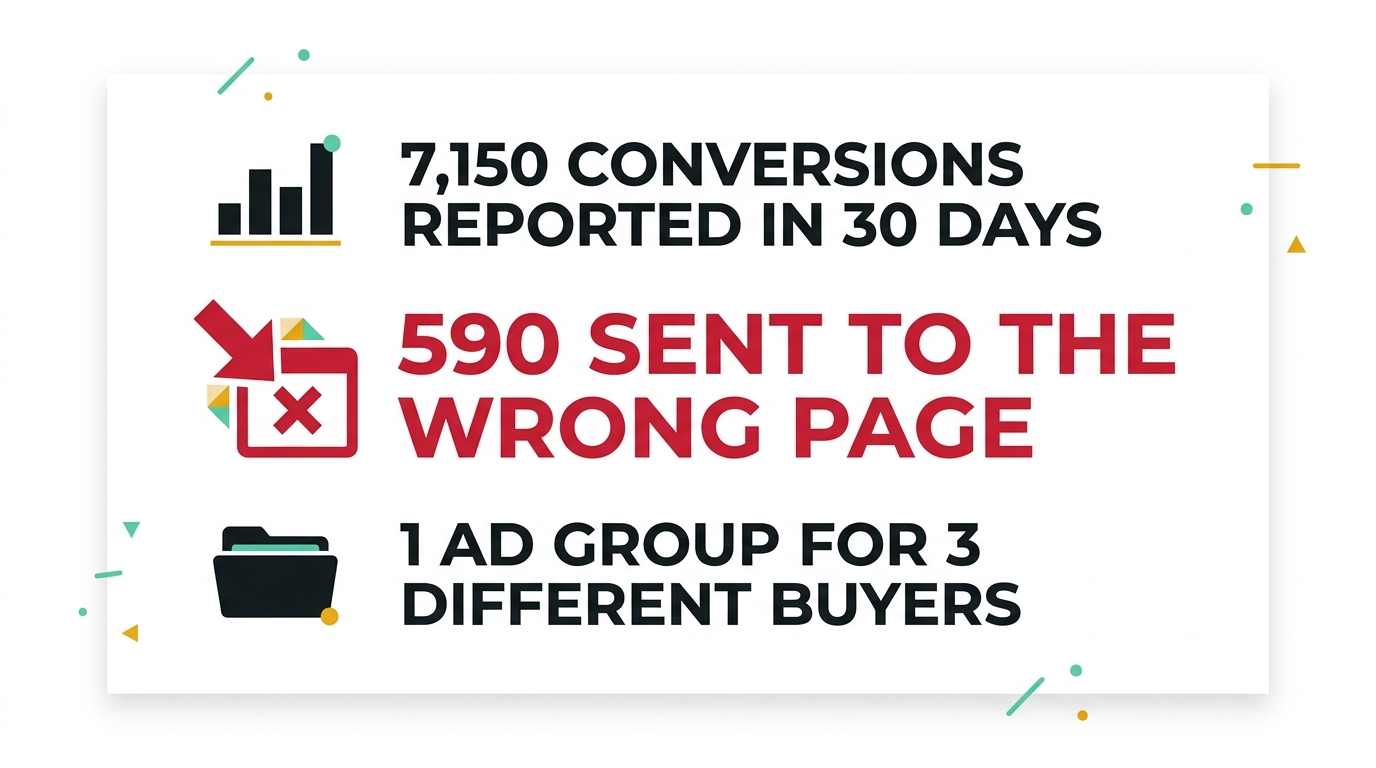
The dashboard showed 7,150 conversions in the last 30 days. It looked brilliant, right up until I opened the account and started reading what those conversions actually were.
Most of them weren’t bookings. They were the same handful of people hitting a thank you page more than once, a phone call given a flat value of $10 whoever called, and a page view counted as if it meant someone had paid.
Why a single ad group can’t serve 3 different buyers
Inside the account, one ad group held everything: people searching for a weekly lesson, people searching for a specific instructor by name, and people searching for an intensive holiday course at nearly $895 a week.
Those are 3 different people with 3 different budgets in mind. A parent looking for a Saturday morning lesson is not the same buyer as a parent who wants their child swimming confidently by the end of half term.
Thrown into 1 ad group, the account couldn’t tell them apart. It just saw clicks and optimised for whichever ones converted cheapest.
Why the automation picked the wrong page, every time
The account had 2 landing pages: one for ordinary lessons, one for the intensive course with its money-back guarantee.
Google’s automated matching, left to its own devices, had decided which page to send people to. Not based on what they’d searched for. Based on which page converted at the lowest cost.
590 clicks in the last month went to the intensive course page, whatever the person had actually typed in. Someone searching for a casual weekly lesson landed on a page quoting $895 and a guarantee they’d never asked about.
An algorithm doesn’t choose the right page. It chooses whichever page is cheapest to say yes on, and calls that a result.
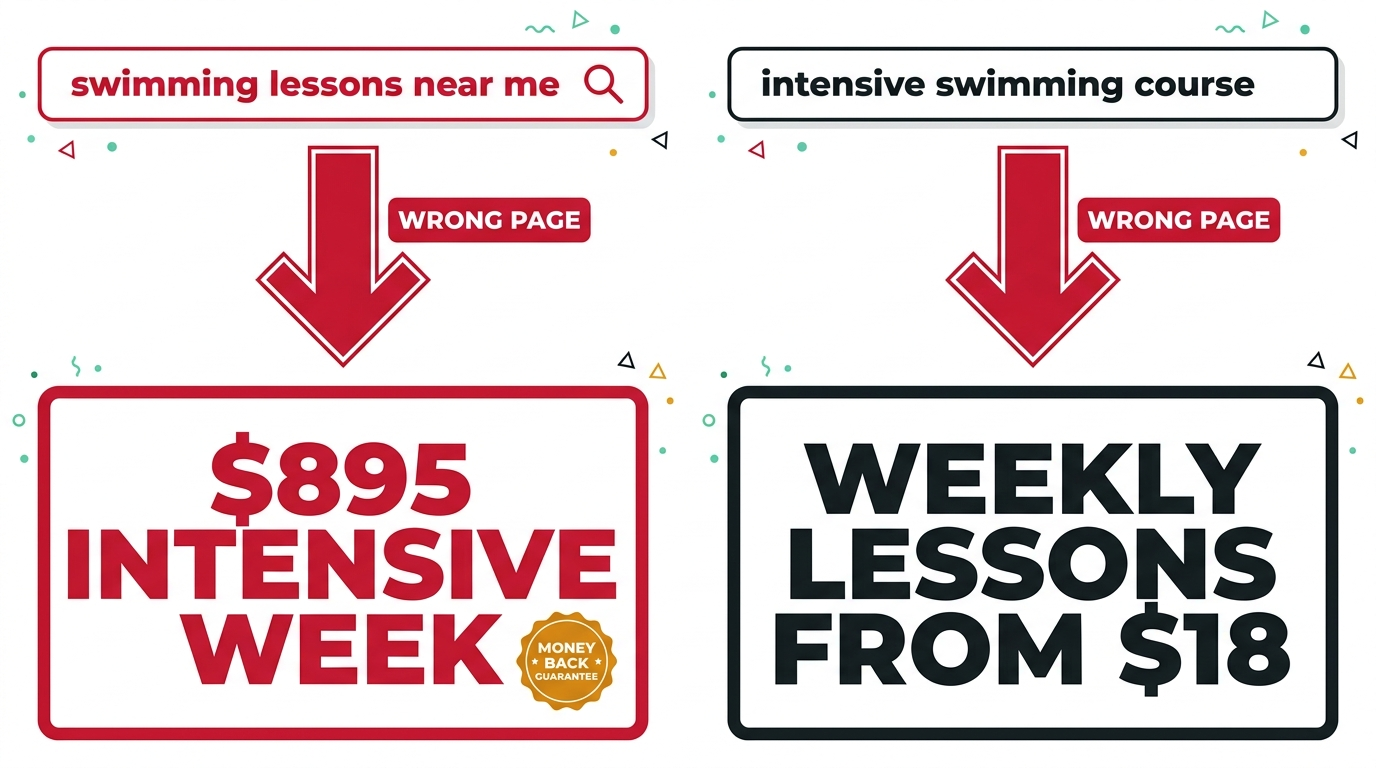
Meanwhile, the people who actually wanted the intensive course, the ones worth nearly 50 times more per booking, mostly landed on the ordinary lessons page instead. Nobody had told the account which buyer was worth protecting.
The keyword nobody meant to add
Buried in the account was a single keyword added by mistake. Someone had tried to add a competitor’s name as an exact match negative and mistyped the brackets, which turned it into a broad match keyword instead.
That accidental keyword was, by some distance, the best performer in the whole account. Nobody had built it, tested it, or chosen it on purpose. It worked because broad match happened to catch the right kind of searcher, once, by chance.
That’s not a strategy. That’s a coin landing on its edge.
How to check your own account for this
- Open each ad group and read every keyword inside it out loud. If you can hear 2 or 3 completely different buyers in the same list, Google can’t tell them apart either, and neither can your landing page.
- Click your own ads from a few different searches and see which page loads. If a cheap, casual search and an expensive, specific search both land on the same page, something is being decided for you, not by you.
Signs the account is rewarding the wrong signal
- Check what’s marked primary against what’s marked secondary in your conversions. A page view or a map direction sitting as primary tells the algorithm that’s success, and it will bring you more people who only ever do that.
- Look for a flat value attached to every phone call. A $10 value on every call treats a 90 second wrong number the same as a booked course, and the algorithm has no reason to prefer one over the other.
The bigger point
Nobody set out to send the wrong people to the wrong page on purpose. The account was simply never split up enough for Google to have a real choice to make.
Automation isn’t the enemy here. Left alone with 1 ad group and 2 pages fighting over the same budget, it did exactly what it was told: find whatever converts cheapest, right now, and do more of that. It was never going to ask whether that search deserved a different answer.
Whether AI should run this unsupervised is a separate question, and the honest answer here is no, not yet, not without someone checking what it’s actually optimising for.
That’s the gap a PPC consultant should be closing before the automation gets anywhere near the account, not afterwards. The fix here wasn’t a bigger budget. It was 3 ad groups instead of 1, each with its own landing page, so the algorithm had an honest choice to make in the first place.
This is also exactly where AI front of house earns its place, reading the account and flagging the mismatch, not quietly running the bidding unsupervised.
A tool that only sees cost per conversion will always choose the cheap page over the right one. It did the same thing with 1 shared campaign that buried a business’s best seller, and with 1 crowded ad group that spoke for every service at once.
If you want to know whether your own account is quietly deciding things for you, the audit checklist is the place to start. You know where I am.
A few questions I get asked
Is it ever fine to let Google’s automated matching choose the landing page? Only once your ad groups are split tightly enough that every click inside one genuinely wants the same thing. If 2 different buyers share a group, the automation isn’t choosing wisely, it’s choosing blind.
How do I know if my conversions are being counted honestly? Open the conversions screen and check which actions are marked primary. Directions, page views and repeat calls from the same number inflate the count without a single new customer behind them.
Should every phone call really have the same value? No. A quick hang-up and a booked course are not worth the same amount, and giving them the same value teaches the algorithm to stop telling them apart.
Does splitting 1 ad group into 3 cost more to manage? It takes more setup, yes, but it’s what lets your budget actually find the buyer worth more to you, instead of whichever one happens to click cheaply this week.
2 ways I can help you get this right
If you want to know what your own account has actually been bidding on, book a free call and we’ll go through it together.
If you’d rather learn to spot this yourself before the next agency hands you a dashboard, my masterclass How to Overtake Your Top Google Ads Competitors in 8 Weeks walks through exactly that.

Claire Jarrett
Google Ads consultant since 2007, published author (6 books), and Google Partner. Claire was the first person to launch Google Ads training in Europe and has helped thousands of professional service businesses scale their leads.
More about Claire